

Single Message View — Reply, Visit, Delete
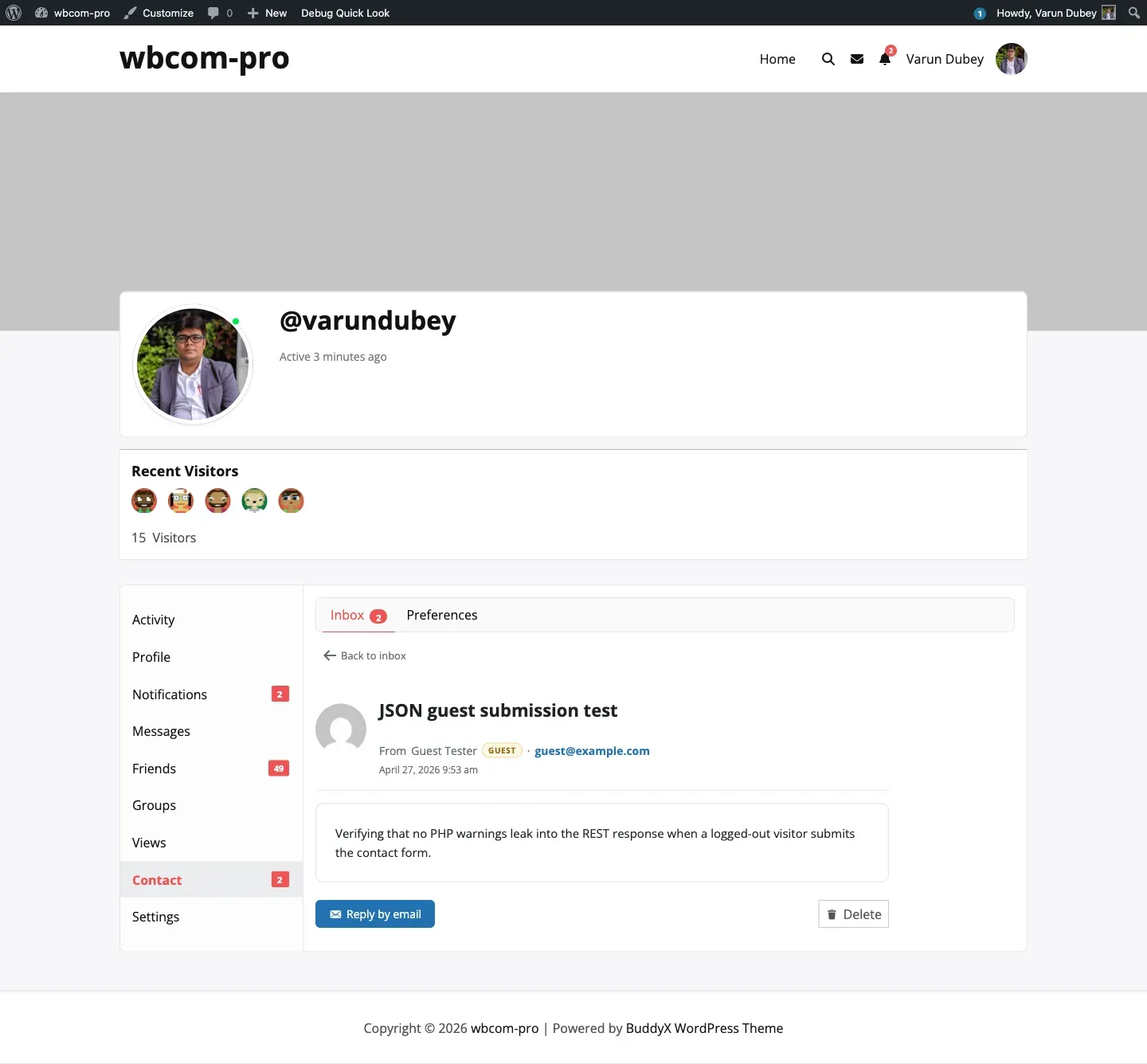
Clicking a message in the inbox opens a full-page view of that one message with all the actions a recipient typically wants.
URL pattern
Section titled “URL pattern”The single-message view lives at /{user-slug}/contact/inbox/{message-id}/. Notification bell links and email “Open in your inbox” links target this URL directly.
If the message ID does not exist or belongs to someone else, the page renders a “Message not found” empty state with a Back to inbox button — never a stranger’s content.
Header
Section titled “Header”The header shows:
- The sender’s avatar (BuddyPress avatar for members, Gravatar fallback for guests).
- The subject, large.
- The sender’s name, linked to their profile if they are a member, otherwise marked with a Guest badge.
- The sender’s email — clickable as a
mailto:for quick reply. - The submission timestamp in the site’s date and time format.
Action buttons
Section titled “Action buttons”A row of action buttons appears below the message body. Which buttons render depends on whether the sender is a member and whether they left contact details:
- Send private message — primary action when the sender is a BuddyPress member and the Messages component is active. Opens the standard BP private-message compose form addressed to them.
- Reply by email — opens a
mailto:with the subject pre-filled asRe: {original subject}. Works for both member and guest senders as long as an email is available. - Visit profile — opens the sender’s profile in a new tab. Only renders for member senders.
- Delete — soft-confirm button that calls the REST delete endpoint with a fresh nonce, then routes back to the inbox.
If the sender left no contact details at all (rare edge case — guest with empty email), the page surfaces a warning that there is no way to reply but still allows delete.
Marking as read
Section titled “Marking as read”Opening the single-message view automatically clears the BuddyPress notification tied to that message — the unread badge in the parent Contact nav and the Unread filter both update on next page load. The mark-as-read step is scoped: only the notification for that specific message is touched, so other unread messages stay flagged.
Delete action
Section titled “Delete action”Clicking Delete calls DELETE /wp-json/bcm/v1/messages/{id} with the wp_rest nonce and the form nonce for defence in depth. The endpoint enforces ownership at the permission layer — it returns 403 if the current user is not the recipient — so deletion is impossible from another account even with a guessed ID.
After a successful delete the page redirects back to the inbox with a flash success message.