

REST: Notifications
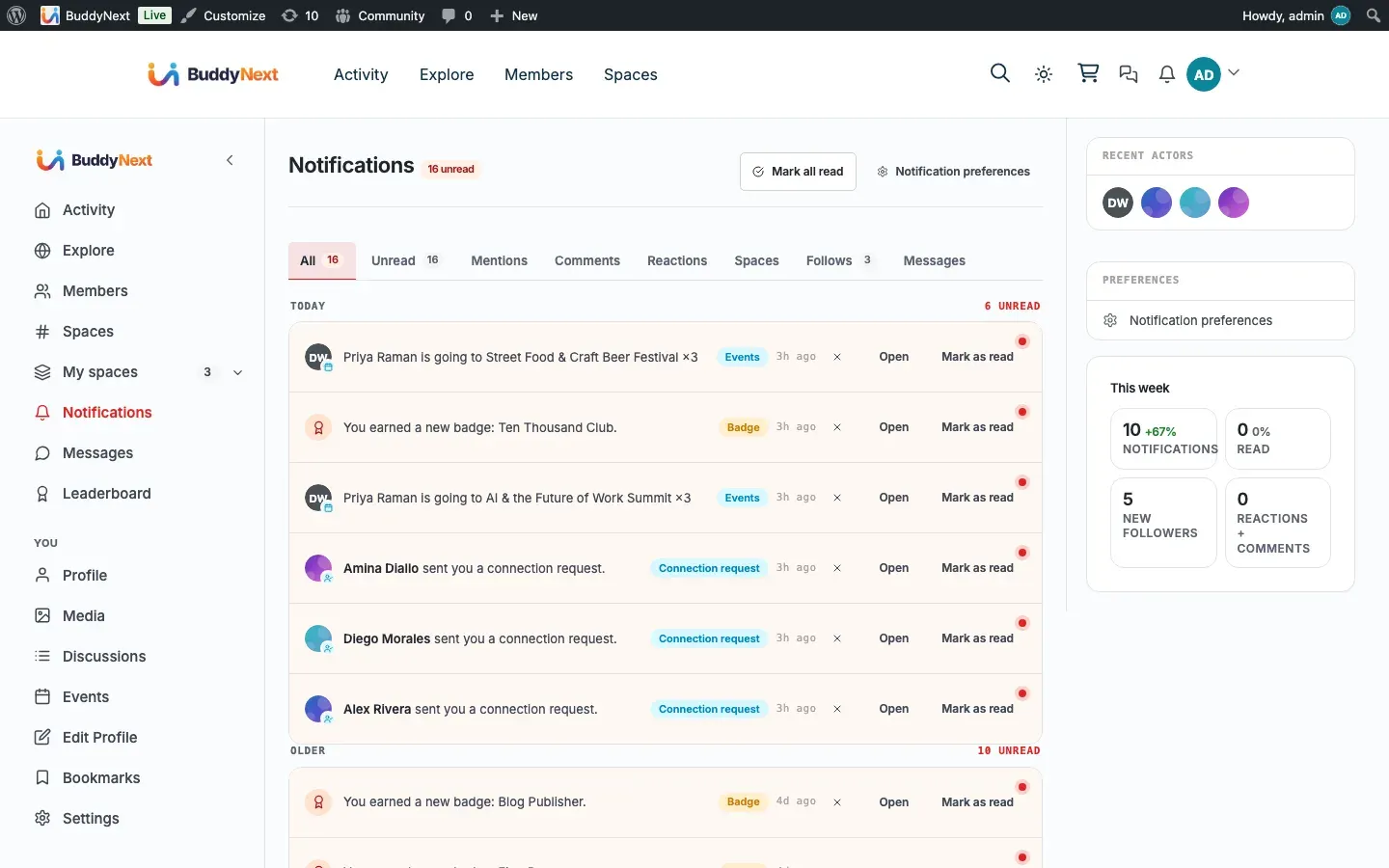
Reference for the notification routes under the buddynext/v1 namespace: the in-app inbox, unread badge, read-state changes, deletion, and the three preference surfaces (per-type, master channels, and per-space). These are the routes an app or custom bell widget uses.
Contract
Section titled “Contract”All routes in this page live under the buddynext/v1 namespace and follow the conventions described in the BuddyNext REST Contract page (envelope, authentication, nonce, and cursor pagination). Read that page first; this page documents only the routes and their request/response shapes.
In short:
- Every route here requires an authenticated user (
require_auth). A guest receives401 rest_not_logged_in. - All routes are scoped to the current user (
/me/...). There is no admin route to read another user’s notifications. - The list endpoint uses cursor pagination via
?cursor=and?per_page=(max 50). - The read-state routes accept
PUT(canonical) and alsoPOST(kept for backwards compatibility).
Note: The
Authcolumn below reflects the route’spermission_callback. Every route resolves toauth(an authenticated user). Finer scoping (you can only act on your own notifications, you must be a member of a space to set its preference) is enforced inside the handler and the service layer.
Routes
Section titled “Routes”| Method | Path | Auth | Purpose |
|---|---|---|---|
| GET | /me/notifications |
auth | List the current user’s notifications, each enriched with a rendered message, link, icon, tone, and label. Accepts ?cursor= and ?per_page= (max 50). |
| GET | /me/notifications/unread-count |
auth | Unread count for the bell badge. |
| PUT | /me/notifications/read-all |
auth | Mark all of the current user’s notifications read. Also accepts POST. |
| PUT | /me/notifications/(?P<id>[\d]+)/read |
auth | Mark one notification read. Also accepts POST. |
| PUT | /me/notifications/(?P<id>[\d]+)/unread |
auth | Mark one notification unread. Also accepts POST. |
| DELETE | /me/notifications/(?P<id>[\d]+) |
auth | Delete one of the current user’s notifications. |
| GET | /me/notification-prefs |
auth | Per-type preferences, with catalogue defaults merged so every type appears once. |
| PUT | /me/notification-prefs |
auth | Update per-type preferences. Body keyed by type, values { on_site, email_freq }. Returns 422 on an invalid email_freq. |
| GET | /me/notification-channels |
auth | Master channel switches (in_app, email, push, sound) plus push_available. |
| PUT | /me/notification-channels |
auth | Update master channel switches. |
| GET | /me/space-notification-prefs |
auth | One row per active space membership with the resolved preference (defaults to all). |
| POST | /me/space-notification-prefs |
auth | Set the current user’s preference for one space. Body: space_id and pref (one of all, mentions_only, none). Non-members get 403. |
Note: There is no
/spaces/{id}/notification-prefroute. Per-space notification preferences are written throughPOST /me/space-notification-prefswithspace_idin the body, so they sit under the/me/...user scope alongside the other preference routes.
Preference value reference
Section titled “Preference value reference”| Surface | Field | Allowed values |
|---|---|---|
Per-type (/me/notification-prefs) |
on_site |
boolean |
Per-type (/me/notification-prefs) |
email_freq |
immediate, daily, weekly, off |
Channels (/me/notification-channels) |
in_app, email, push, sound |
boolean |
Per-space (/me/space-notification-prefs) |
pref |
all, mentions_only, none |
When the Pro push module is not loaded, push_available is false and the push channel defaults off so the client can hide the row without a separate feature-flag request.
Examples
Section titled “Examples”List notifications
Section titled “List notifications”curl 'https://example.com/wp-json/buddynext/v1/me/notifications?per_page=20' \ -H 'X-WP-Nonce: <nonce>' \ --cookie 'wordpress_logged_in_...=<cookie>'The response wraps the raw rows with a presentation layer (message, url, icon, tone, label, actor_name) so the in-app dropdown, mobile app, and email tokens all render the same way, plus a cursor for the next page:
{ "items": [ { "id": 9051, "user_id": 12, "type": "bn.new_follower", "actor_id": 47, "is_read": 0, "created_at": "2026-06-20 08:55:11", "message": "Priya started following you.", "url": "https://example.com/members/priya/", "icon": "user-plus", "tone": "info", "label": "New follower", "actor_name": "Priya" } ], "next_cursor": "eyJpZCI6OTA1MX0", "has_more": false}Update a per-type preference
Section titled “Update a per-type preference”curl -X PUT 'https://example.com/wp-json/buddynext/v1/me/notification-prefs' \ -H 'X-WP-Nonce: <nonce>' \ -H 'Content-Type: application/json' \ --cookie 'wordpress_logged_in_...=<cookie>' \ -d '{ "bn.new_follower": { "on_site": true, "email_freq": "daily" } }'A valid update returns the resolved preference set (catalogue defaults merged with the stored rows) and a server timestamp. An invalid email_freq returns 422 invalid_email_freq with a params map naming the offending type(s).
- The list route hydrates each row through the notification message composer; clients should render
message/url/icon/tone/labeldirectly rather than re-deriving copy fromtype. - Read-state and delete routes only ever touch the current user’s own rows; passing another user’s notification id returns a
WP_Errorfrom the service rather than mutating it. - Free vs Pro: all routes on this page are in the free plugin. Pro’s push module adds a delivery channel (surfaced via the
pushchannel andpush_availableflag) but registers no additional routes here.