

Developer Overview
BuddyNext is a social-community plugin for WordPress that ships its features as REST-backed, theme-overridable modules. This page is the entry point to the developer guide: it explains the Free/Pro split, the frontend and templating model, the contract-first design philosophy, and a current stat snapshot of the codebase.
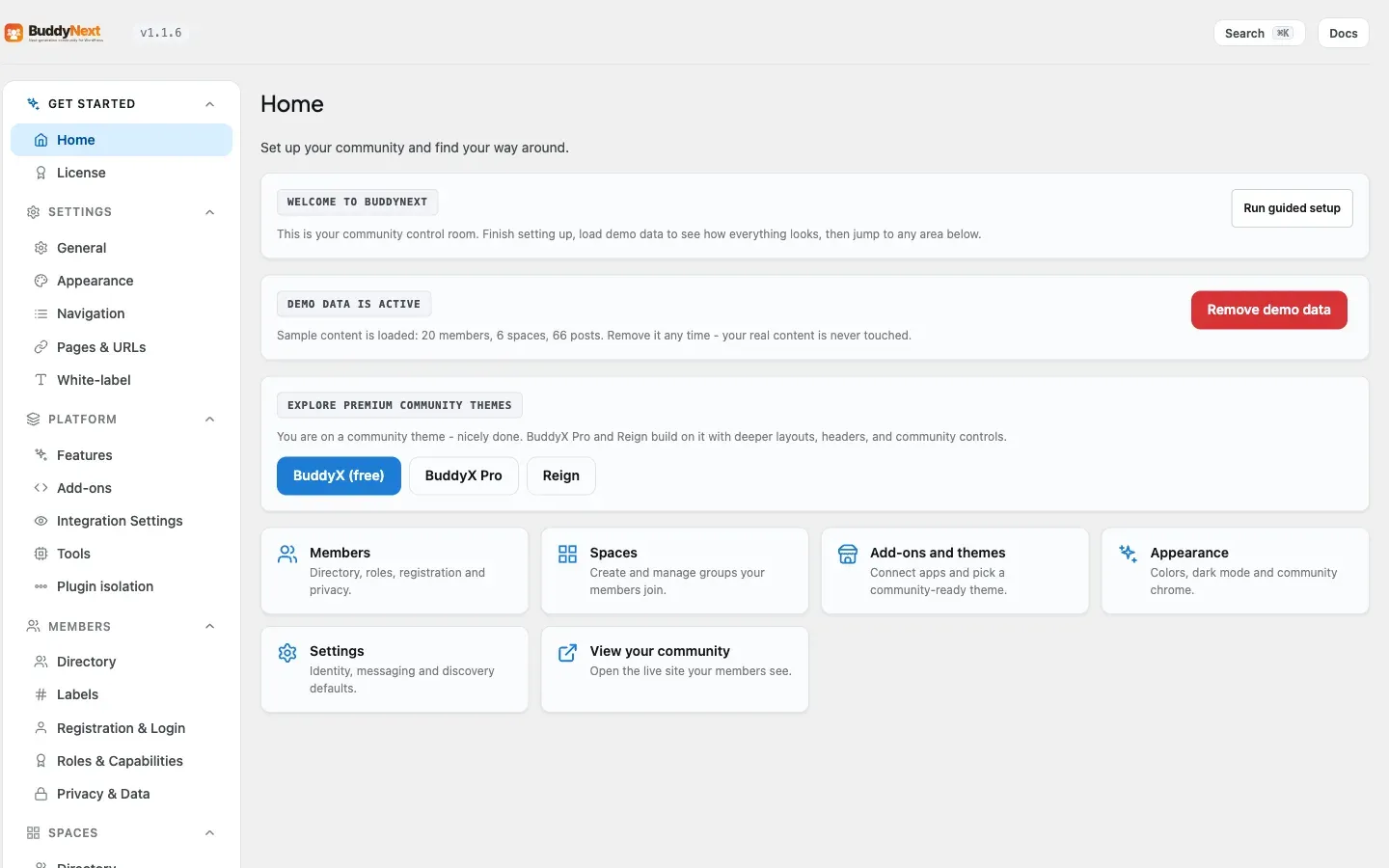
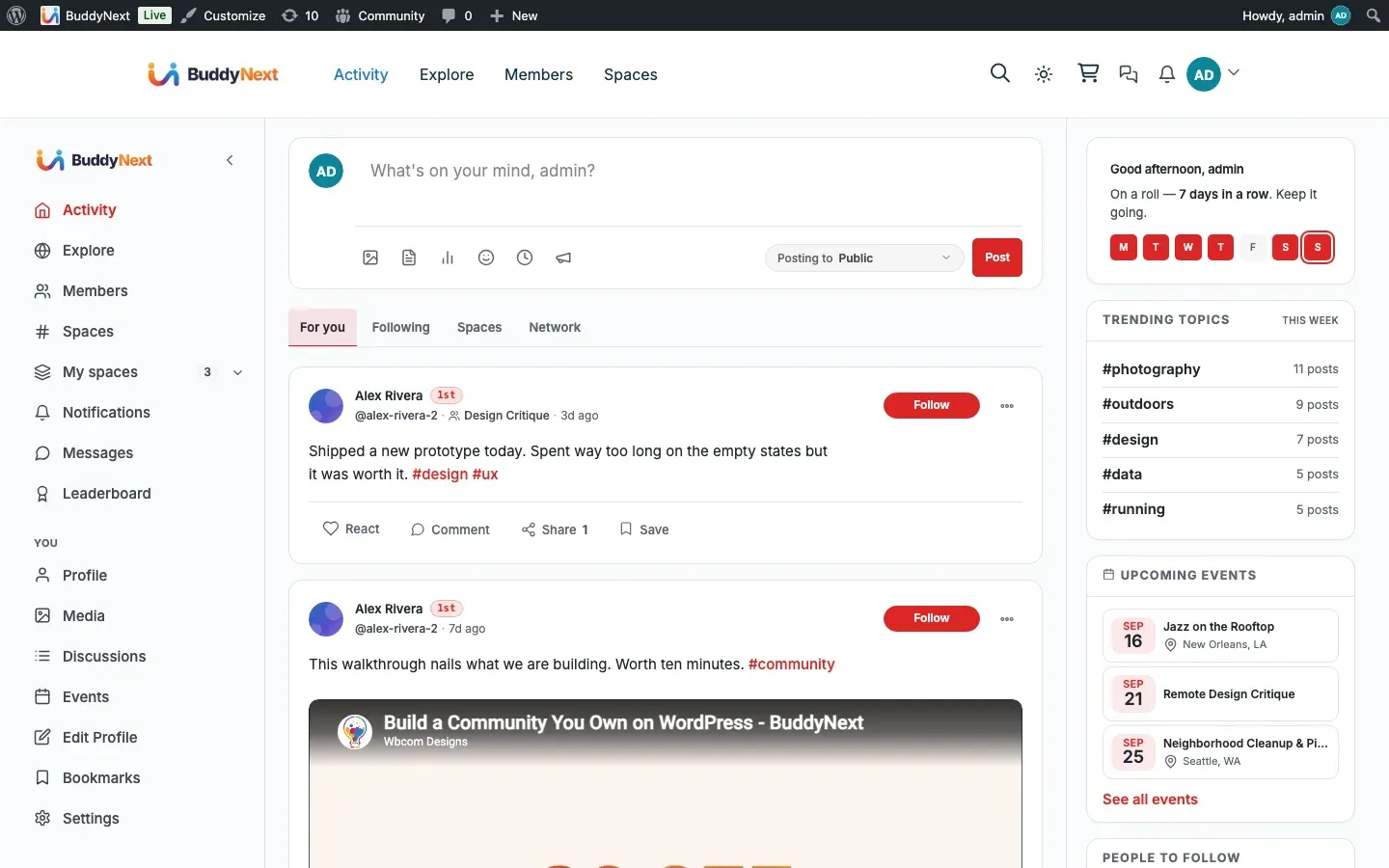
What you are building on
Section titled “What you are building on”BuddyNext is “the social layer for WordPress” - follows, connections, an activity feed, spaces, profiles, member directory, search, notifications, email, reactions, comments, hashtags, moderation, and a direct-messaging UI. Each of these is a self-contained feature module, and every module exposes its contracts through three stable surfaces: a REST namespace (buddynext/v1), a large set of action and filter hooks, and theme-overridable PHP templates.
The product is split into two plugins:
Free (buddynext) |
Pro (buddynext-pro) |
|
|---|---|---|
| Namespace | BuddyNext\* |
BuddyNextPro\* |
| REST namespace | buddynext/v1 |
buddynext-pro/v1 |
| Bootstrap | plugins_loaded:15 -> BuddyNext\Core\Plugin::init() -> fires buddynext_loaded |
plugins_loaded:20 -> BuddyNextPro\Core\Plugin::init() |
| Relationship | Standalone, fully functional community | extends Free - consumes Free services, hooks, and tables; never forks them |
| Requires | WordPress 6.9+, PHP 8.1+ | WordPress 6.9+, PHP 8.1+ |
Pro boots after Free and extends it through the documented seams - it rebinds container services, listens on Free hooks, and reads Free tables. Pro never copies Free’s logic. Licensing gates updates only; it never gates functionality, so the Free plugin is a complete community on its own.
How the frontend works
Section titled “How the frontend works”BuddyNext has no React build step and no bundler. Two choices make this possible:
- REST-driven. Every frontend state change goes through the REST API, not
admin-ajax. Reads and writes share one envelope and one nonce contract. The browser talks tobuddynext/v1directly. (See the REST contract page for the envelope, auth, and pagination rules.) - WordPress Interactivity API. Client behaviour is authored as Interactivity API stores - ES modules under
assets/js/{feature}/store.js, each namespacedbuddynext/{feature}. There is no React, no JSX, no jQuery, and nothing to compile. The plugin ships runnable JS and ships its production dependencies vendored, so a customer never runs a build command.
Frontend pages render inside the active theme’s chrome. Every BuddyNext hub (activity, members, spaces, messages, notifications, auth, onboarding, moderation) is wrapped by the theme’s get_header() / get_footer(); the plugin’s shell renders only the rail, main column, and an optional right sidebar between them. There is no shell-takeover mode and no opt-out filter - one render path, one test surface.
Theme-overridable templates
Section titled “Theme-overridable templates”All markup lives in PHP templates that themes can override by copying into {theme}/buddynext/. The buddynext_get_template() helper checks the active theme’s path first and the plugin path second, so a theme can replace any partial without touching the plugin. Reusable partials under templates/parts/ fire before/after actions and an args filter around their output, so you can extend a part without overriding it.
Contract-first philosophy
Section titled “Contract-first philosophy”The guiding principle is recorded in the spec index:
Minimal by default, extensible by design. Ship the essential feature. Cover it with hooks. Let the ecosystem add layers.
In practice this means the core stays small and every feature is a folder under includes/{Feature}/ with up to four canonical files - Service (business logic and DB access), Controller (REST), Listener (hook registrations), and Cache. Services never render templates; templates never run raw SQL. Features never call each other directly - they communicate through hooks, filters, or container lookups. Pro, bridges, child themes, and third-party plugins extend BuddyNext through seven documented surfaces (new feature modules, hooks and filters, container rebinding, template-part overrides, the right-sidebar action, hub before/after hooks, and REST namespace separation) rather than by editing core.
Every Layer 2 feature is also opt-out via a buddynext_feature_{folder} filter (default true), so a deployment can run in minimal mode (Core plus Bridges) or enable only the features it needs.
Stat snapshot
Section titled “Stat snapshot”Counted from the source of both plugins. Figures move with each release; confirm anything load-bearing against the code.
| Metric | Free | Pro |
|---|---|---|
| PHP files | 357 | 132 |
| Total PHP lines | 127,409 | - |
| JS files | 41 | - |
| CSS files | 29 | - |
| REST endpoints | 168 (buddynext/v1) |
48 (buddynext-pro/v1) |
| Database tables | 41 | 22 |
| Unique hooks fired | 633 (619 buddynext_*) |
34 |
| Cron events | 6 | 4 |
Note: These figures are a manifest snapshot and can lag the code between refreshes; they are regenerated at release. For the current block count see the Blocks Reference, and for the current version string see
readme.txt. When a count here disagrees with the source, trust the source.
How this guide is organized
Section titled “How this guide is organized”This developer guide covers the contracts you build against:
- Getting started - local requirements, where code lives, the two WP-CLI commands, and how to run the quality gates. (See Getting Started for Developers.)
- REST API - the request/response envelope, auth, pagination, and the per-feature route tables for both namespaces.
- Hooks and filters - the action and filter reference, organized by feature, with example extension snippets.
- Database schema - per-table column references, indexes, and the scale rules (denormalized counters, cursor columns) that shaped them.
- Templates and theming - the override mechanism, template-part contracts, and the shell composition model.
- Blocks - the registered Gutenberg blocks and their attributes.
Where the deep specs live
Section titled “Where the deep specs live”The website developer guide is the curated, contract-facing reference. Behind it, the code is the contract - Free ships no docs/specs/*.md. An earlier revision of this page pointed at an INDEX.md, MODULAR-ARCHITECTURE.md, HOOKS.md, REST-FRONTEND-CONTRACT.md, SCALE-CONTRACT.md, and FREE-VS-PRO.md under docs/specs/, and none of them exist. Read the source instead:
- The per-domain hooks pages (25-33) for the
buddynext_*action and filter reference. - The template PHP file headers under
templates/andtemplates/parts/for the template-part contracts. register_rest_route(for routes,do_action(/apply_filters(for hooks,FeatureRegistry::catalog()for features, andInstaller::schema()for thebn_*tables.
When a doc and the source disagree, the current source wins - includes/ reflects what actually ships.