

REST Meta Filters
The GET /wcb/v1/jobs REST endpoint accepts postmeta filters via
?meta_<key>=<value>. The Job Listings block exposes the same
surface through its metaFilter attribute.
Default-allow rule (1.2.0+)
Section titled “Default-allow rule (1.2.0+)”Any meta key in the _wcb_* namespace is allowed by default. The
plugin owns that prefix, so there is no probe risk for fields like
_wcb_visa_sponsorship, _wcb_seniority_score, _wcb_department,
etc. Drop the block in the editor or hit the REST endpoint directly
without any PHP setup:
GET /wp-json/wcb/v1/jobs?meta__wcb_visa_sponsorship=1GET /wp-json/wcb/v1/jobs?meta__wcb_department=engineering[wcb_job_listings metaFilter="_wcb_visa_sponsorship:1"][wcb_job_listings metaFilter="_wcb_department:engineering"]Custom (non-WCB) meta still needs opt-in
Section titled “Custom (non-WCB) meta still needs opt-in”Custom or third-party meta keys - anything that doesn’t start with
_wcb_ - still need to be added to the wcb_jobs_allowed_meta_filters
filter before they can be queried. This prevents anonymous probes
against arbitrary site-internal postmeta (e.g. a private membership
flag set by another plugin):
add_filter( 'wcb_jobs_allowed_meta_filters', function( $keys ) { $keys[] = 'partner_company_id'; // not _wcb_*, must opt in $keys[] = 'crm_sync_state'; // same return $keys;} );Then anonymous callers can hit:
GET /wp-json/wcb/v1/jobs?meta_partner_company_id=42Why this split?
Section titled “Why this split?”Without any allowlist, any caller could query against any postmeta - including private fields the plugin or other plugins use for internal
bookkeeping (e.g. _wcb_employer_banned, _wcb_pending_review_token,
or a membership plugin’s _member_level field). The pre-1.2.0
behavior required allowlisting every key, which made the common case
(filter jobs by a _wcb_* field set by the plugin itself) require
PHP. The 1.2.0 split allows the namespace WCB owns while still gating
foreign meta.
Block + shortcode integration
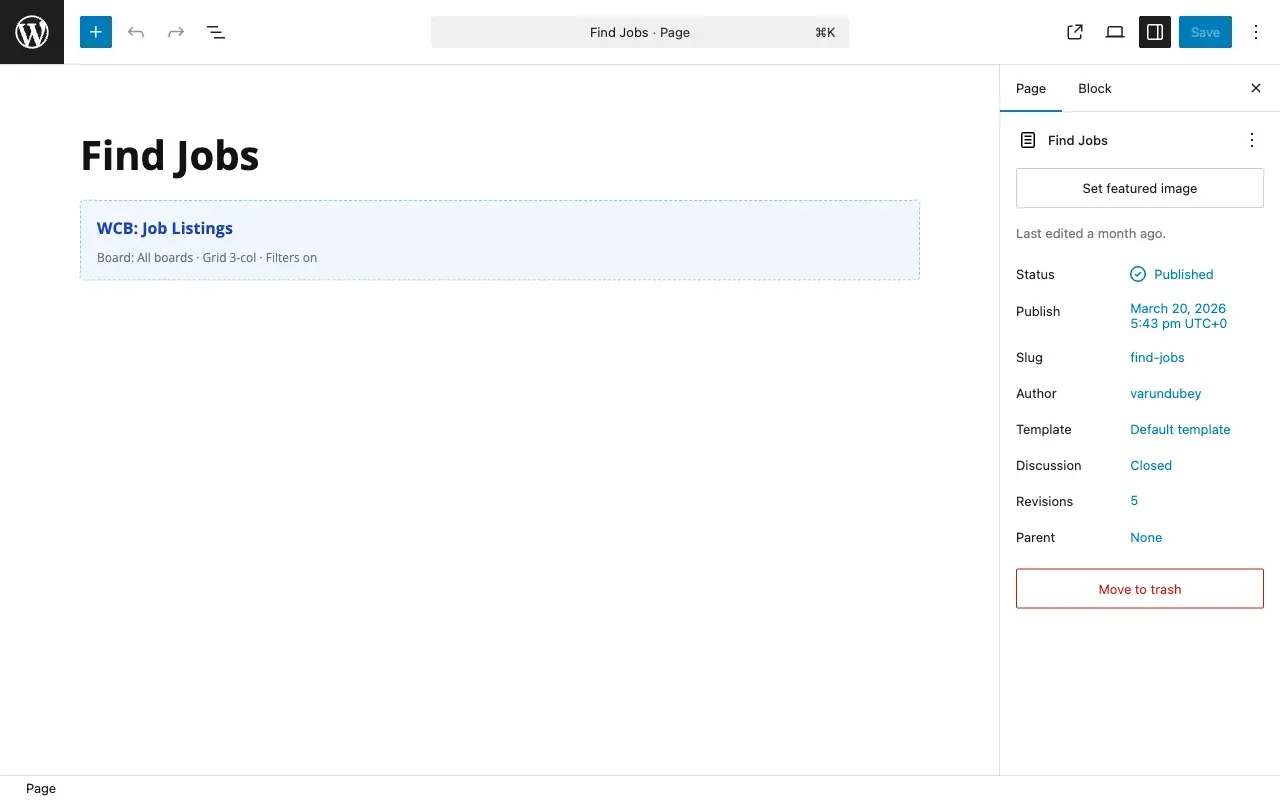
Section titled “Block + shortcode integration”The Job Listings block exposes a metaFilter attribute on every
shipped surface - Gutenberg inserter, shortcode wrapper, and
page-builder embeds:
If you reference a key that’s NOT in the _wcb_* namespace and NOT
on the explicit allowlist, the block falls back to showing all jobs
(no error, but the filter is silently ignored) and a
_doing_it_wrong notice fires in WP_DEBUG mode telling you which
filter to register.
Matching behavior
Section titled “Matching behavior”Each meta_<key>=<value> filter adds one exact-match meta_query
clause (key + value). There is no special _min / _max suffix
or comma-list expansion - the value you pass is matched verbatim
against the stored postmeta. The dedicated salary range is handled by
the separate ?salary_min= / ?salary_max= query parameters, not by
the meta-filter surface.
Common patterns
Section titled “Common patterns”Boolean meta
Section titled “Boolean meta”$keys[] = '_wcb_visa_sponsorship';$keys[] = '_wcb_relocation_offered';$keys[] = '_wcb_remote_friendly';These three are already in the _wcb_* namespace, so they work
without any allowlist registration. On the front end:
?meta__wcb_visa_sponsorship=1?meta__wcb_relocation_offered=1Register a key with wcb_jobs_allowed_meta_filters only when it is
NOT in the _wcb_* namespace (a third-party key like
partner_company_id).
Single-value meta
Section titled “Single-value meta”?meta__wcb_department=engineeringReturns jobs whose _wcb_department postmeta equals engineering
exactly.
Performance notes
Section titled “Performance notes”- All meta filters are added to the WP_Query
meta_queryarray. WordPress core handles indexing. - For high-traffic boards, add an index on the relevant rows in
wp_postmeta:ALTER TABLE wp_postmeta ADD INDEX wcb_meta_visa (meta_key, meta_value(20)); - The jobs REST endpoint caches each query result (keyed by the query arguments) in a transient for 5 minutes. The TTL is fixed and the cache is cleared automatically when a job is saved.
See also
Section titled “See also”- Custom fields filter API - declare custom fields on the job form so employers can fill them when posting.
- Page-builder embeds - scope listings via
metaFiltershortcode attribute.