

REST: Webhooks
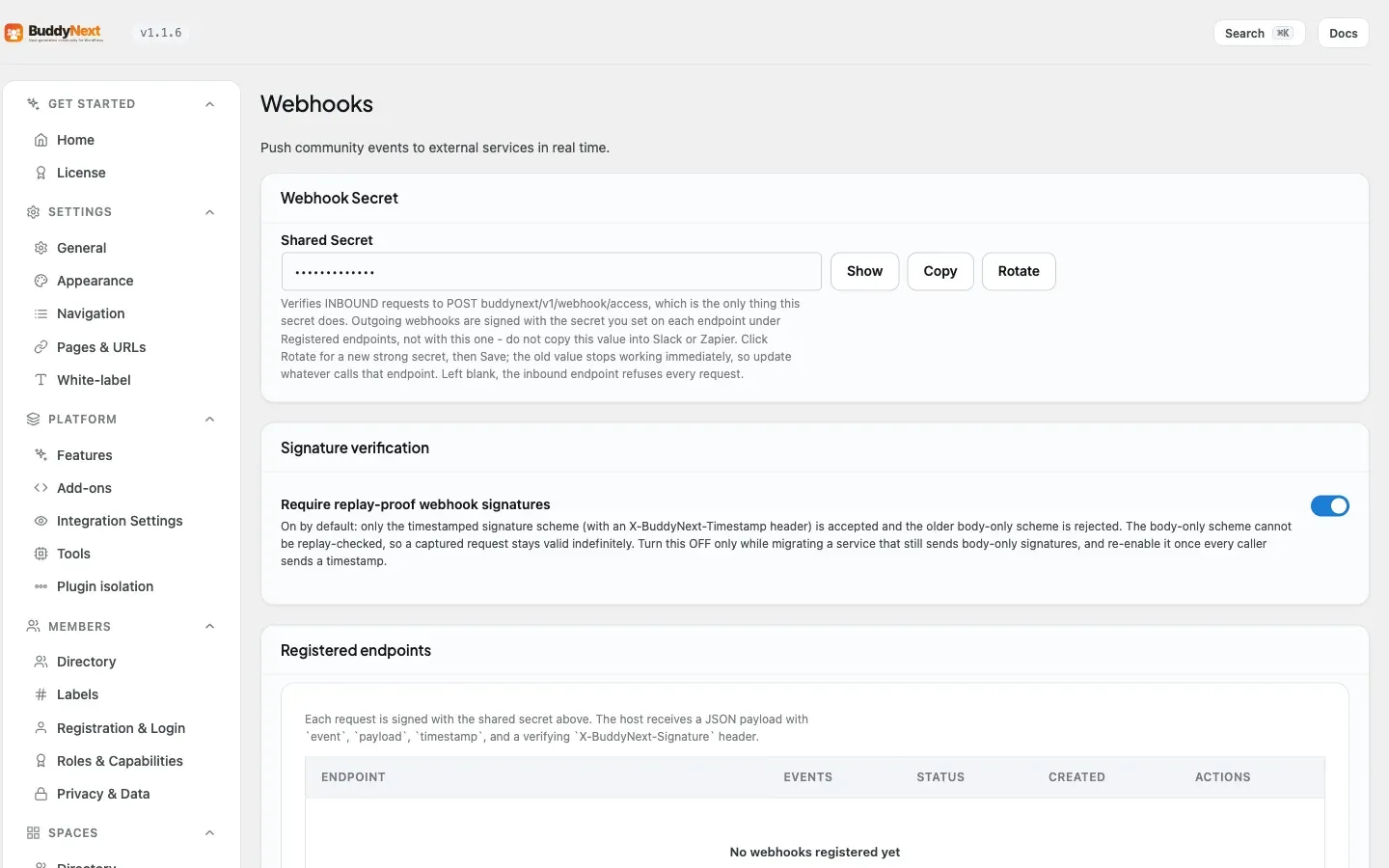
BuddyNext exposes two webhook surfaces: an outbound CRUD surface that registers external endpoints the site POSTs lifecycle events to, and a single signed inbound endpoint that lets a trusted external service manage a user’s role, abilities, and credits. This page covers both. The namespace, auth header, envelope, and error shape are defined on the REST Contract page - read it first.
Overview / Contract
Section titled “Overview / Contract”The outbound webhook feature is an opt-in feature (webhooks, plan opt_in, group integrations). It is off by default. The owner enables Webhooks in Settings before the CRUD routes register: REST/Router.php only registers the outbound CRUD controller when features->is_enabled( 'webhooks' ) is true. Until then, /webhooks* is not on the wire and the admin screen shows a “Webhooks are turned off” notice.
Free caps a site at 1 registered outbound endpoint. The cap is applied at registration time via the buddynext_outbound_webhook_limit filter (default 1), checked against all rows in bn_outbound_webhooks (active or inactive). Exceeding it returns a 422 webhook_limit_reached. Pro lifts the cap by returning a higher integer (or PHP_INT_MAX) from the filter.
The outbound CRUD routes all require the manage_options capability. The inbound access endpoint is unauthenticated at the nonce layer (permission_callback => '__return_true') and instead verifies an HMAC-SHA256 signature inside the handler.
Route table
Section titled “Route table”| Method | Path | Auth | Purpose |
|---|---|---|---|
| GET | /buddynext/v1/webhooks |
manage_options |
List all registered outbound endpoints |
| POST | /buddynext/v1/webhooks |
manage_options |
Register a new endpoint (returns id + signing secret) |
| PUT | /buddynext/v1/webhooks/{id} |
manage_options |
Update an endpoint (url, events, is_active, or rotate secret) without delete+recreate |
| DELETE | /buddynext/v1/webhooks/{id} |
manage_options |
Delete an endpoint and its delivery log |
| GET | /buddynext/v1/webhooks/{id}/log |
manage_options |
Paginated delivery log (per_page max 100, page) |
| POST | /buddynext/v1/webhooks/{id}/test |
manage_options |
Send a test ping to the endpoint |
| POST | /buddynext/v1/webhook/access |
HMAC-SHA256 signature | Inbound: manage a user’s role, abilities, or credits |
Note: The outbound routes are plural (
/webhooks). The inbound access endpoint is singular (/webhook/access) and is a different surface with a different auth model. They are not gated by thewebhooksopt-in feature in the same way - the access endpoint registers whenever its controller boots, but every request must carry a valid signature, and it returns 503 if no secret is configured.
Outbound: register and manage endpoints
Section titled “Outbound: register and manage endpoints”POST /webhooks accepts:
| Param | Type | Required | Notes |
|---|---|---|---|
url |
string | yes | Must begin with https:// and be a valid URL, or the call returns 422 invalid_url |
secret |
string | no | HMAC signing secret. Omit it and the server generates a 40-character secret and returns it once |
events |
array of string | no | Event slugs to subscribe to. Empty (the default) subscribes to all events |
The signing secret is returned in the create response and is the only time the generated value is shown. Outbound deliveries are signed with HMAC-SHA256 using this secret and sent off-request; a delivery that fails is retried with exponential backoff, and an endpoint that accumulates three consecutive failures is automatically deactivated.
PUT /webhooks/{id} updates an existing endpoint in place. Send only the fields you want to change - any of url, events, is_active (re-enable a deactivated endpoint), or secret (rotate the signing secret). It returns {"success": true, "id": <id>}.
Request/response example
Section titled “Request/response example”Register an endpoint:
curl -X POST 'https://example.com/wp-json/buddynext/v1/webhooks' \ -H 'X-WP-Nonce: 5f3a9c2b1d' \ -H 'Content-Type: application/json' \ --cookie 'wordpress_logged_in_...=...' \ -d '{ "url": "https://hooks.example.net/buddynext", "events": ["post.created", "user.followed"] }'Success response (201) - note the one-time secret:
{ "id": 7, "secret": "n3vMq1Xk7pR2sT9bL0cZ8dF4gH6jK1mN5wA3eY2"}Registering a second endpoint on Free (cap reached) returns 422:
{ "code": "webhook_limit_reached", "message": "You have reached the maximum number of registered webhook endpoints.", "data": { "status": 422 }}Delivery log and test ping
Section titled “Delivery log and test ping”GET /webhooks/{id}/log returns the paginated per-attempt delivery log (per_page defaults to 20, max 100; page defaults to 1). POST /webhooks/{id}/test sends a test ping and returns:
{ "success": true, "message": "Test ping delivered successfully."}A failed test ping returns the same shape with "success": false and a 502 status, pointing the caller at the delivery log.
Inbound: the access endpoint
Section titled “Inbound: the access endpoint”POST /webhook/access lets a trusted external service (for example a billing system) change a BuddyNext user’s access. Every request must carry an X-BuddyNext-Signature header of the form sha256=<hmac>, where the HMAC is computed over the raw request body using the shared secret stored in the buddynext_webhook_secret option (set on the admin settings page). The handler compares signatures with hash_equals.
Outcomes:
- No secret configured: 503
webhook_not_configured. - Signature mismatch: 401
invalid_signature. - Body is not valid JSON: 400
invalid_payload. - User cannot be resolved: 404
user_not_found. - Unknown
action: 400unknown_action.
The target user is resolved from user_id or user_email in the body. Every call - success or error - is written to bn_webhook_log for auditing.
action |
Effect |
|---|---|
set_role |
Set the community role (admin, moderator, or member); fires buddynext_role_changed |
grant_ability |
Grant a BuddyNext ability with optional expires_at; fires buddynext_ability_granted |
revoke_ability |
Remove a granted ability; fires buddynext_ability_revoked |
add_credits |
Add amount to the user’s credit balance |
set_credits |
Replace the user’s credit balance with amount |
deduct_credits |
Subtract amount (floors at 0) |
Request/response example
Section titled “Request/response example”BODY='{"action":"grant_ability","user_email":"member@example.com","ability":"post-in-feed","expires_at":"2026-12-31","source":"stripe"}'SIG="sha256=$(printf '%s' "$BODY" | openssl dgst -sha256 -hmac "$WEBHOOK_SECRET" | awk '{print $2}')"
curl -X POST 'https://example.com/wp-json/buddynext/v1/webhook/access' \ -H "X-BuddyNext-Signature: $SIG" \ -H 'Content-Type: application/json' \ -d "$BODY"Success response (200):
{ "success": true }Notes / gotchas
Section titled “Notes / gotchas”- The generated outbound
secretis shown only in thePOST /webhooksresponse. Store it on creation; it is not returned again byGET /webhooks. - The outbound CRUD routes only exist when the
webhooksopt-in feature is enabled. If the routes 404, confirm the feature is turned on in Settings before debugging auth. - Free is capped at 1 outbound endpoint. To raise the cap in Pro or a custom build, return a higher integer from
buddynext_outbound_webhook_limit. - The inbound
/webhook/accessendpoint signs over the raw request body. Compute the HMAC on the exact bytes you send - any re-serialization (whitespace, key reordering) changes the signature and produces a 401. - The two surfaces use different secrets: outbound deliveries are signed with the per-endpoint secret returned at registration; inbound requests are verified against the single
buddynext_webhook_secretoption.
If your system runs inside this WordPress install
Section titled “If your system runs inside this WordPress install”The /webhook/access endpoint is the door for a system that cannot run PHP in your process — a hosted CRM, a separate site, a payment platform calling in over HTTP.
A WordPress plugin on the same install should not use it. It would be signing an HTTP request to itself, and it would still have to declare its source, answer for its own name, supply a management URL and survive being deactivated. All of that is already written.
Extend AbstractGrantBridge instead — see Membership Grant Bridges. It fires the same grant contract this endpoint fires, so the two doors land in exactly one place and cannot behave differently.
One thing to know if you fire buddynext_ability_granted directly rather than through either door: the $source argument is honoured only for a source declared through buddynextpro_integration_subscription_sources. An undeclared source is silently recorded as manual, which tells the member their membership was comped and points their Cancel and Manage controls at the wrong system. The grant itself works, so nothing fails and nobody notices.