

Architecture Overview
This page is the map of how BuddyNext is put together: the five layers, the order they boot in, the canonical shape of a feature module, the DI container, and the PageRouter hub lifecycle. Read it before adding a feature, a bridge, or an admin page - every later chapter assumes this model.
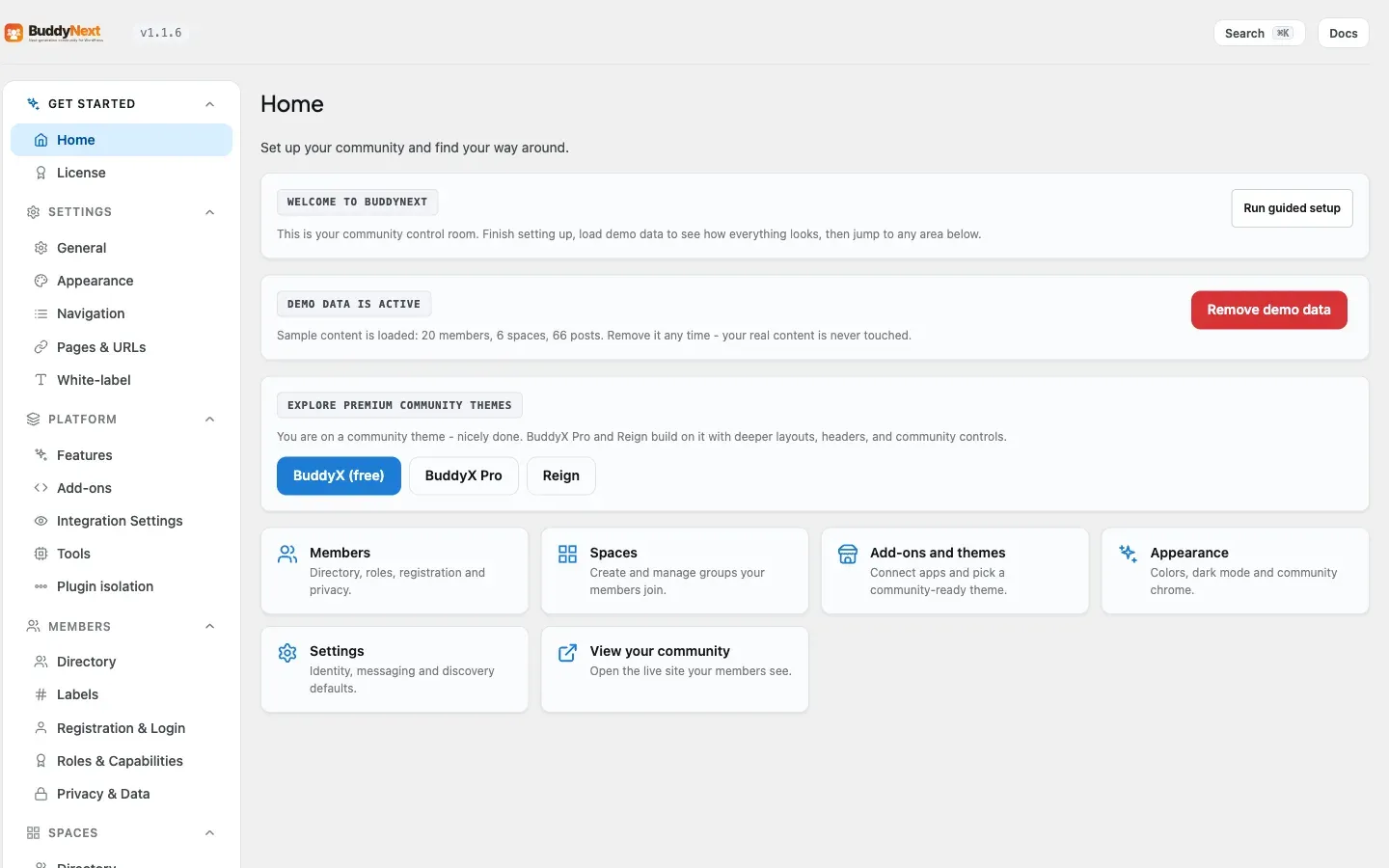
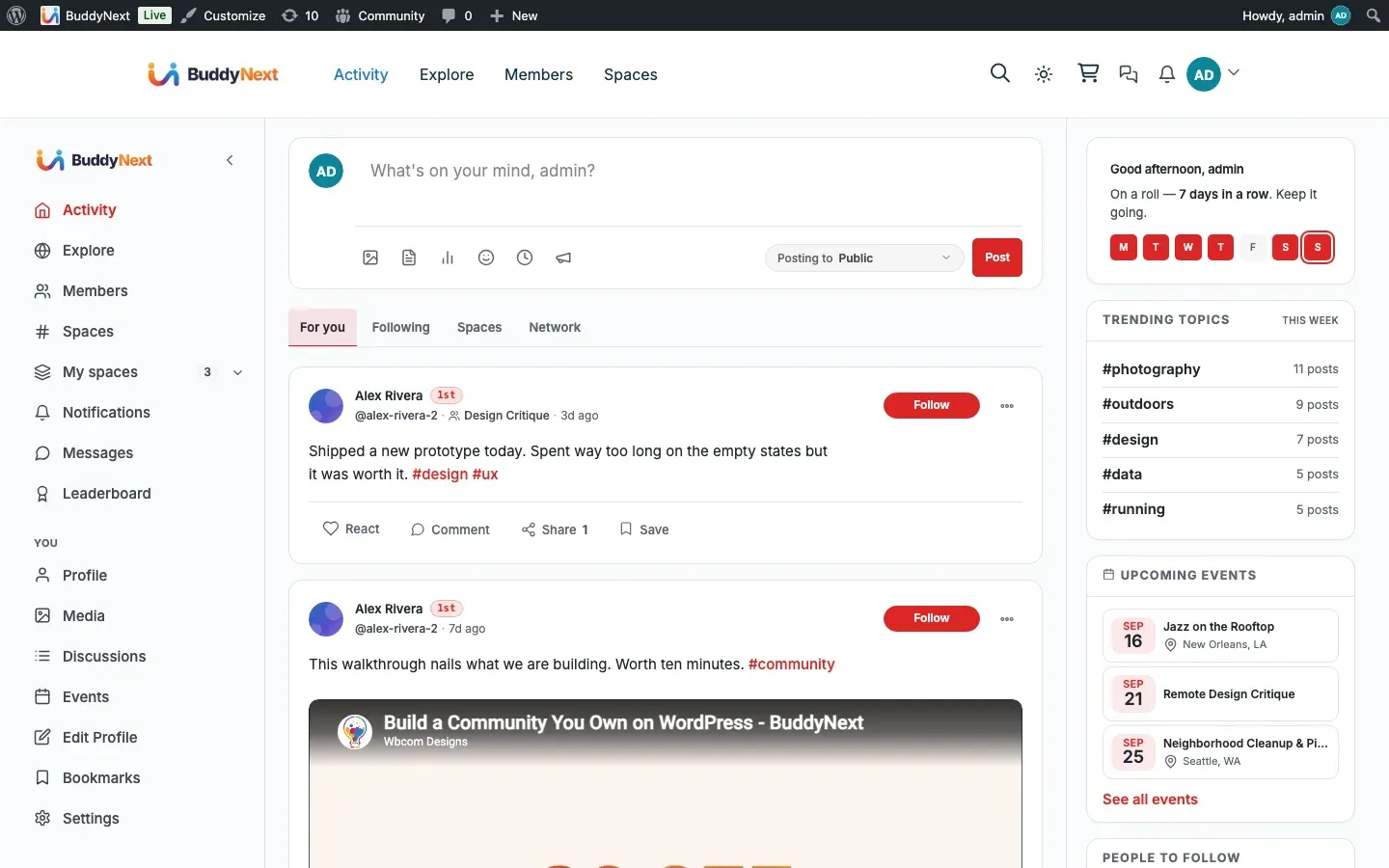
BuddyNext is namespaced BuddyNext\* (free) / BuddyNextPro\* (pro), autoloaded PSR-4 from includes/. It boots at plugins_loaded:15 via BuddyNext\Core\Plugin::init().
The layered model
Section titled “The layered model”Every feature is grouped by component and core. Cross-layer dependencies only point downward (a higher layer may call a lower one; never the reverse). The arrows below show the allowed direction.
+----------------------------------------------------------------------+| LAYER 4 Composition (hub templates) || templates/{hub}/index.php composes Layer 3 + Layer 2 || the active theme owns get_header()/get_footer(); || the shell owns the .bn-app canvas; the inner template owns content |+----------------------------------------------------------------------+ ^ calls UI parts + services+----------------------------------------------------------------------+| LAYER 3 UI components || templates/parts/*.php reusable partials (hook + filter) || assets/css/bn-{feature}.css one stylesheet per feature || assets/js/{feature}/store.js Interactivity API store |+----------------------------------------------------------------------+ ^ fetches data from services+----------------------------------------------------------------------+| LAYER 2 Feature modules (includes/{Feature}/) || {Feature}Service.php business logic + DB || {Feature}Controller.php REST endpoints (thin) || {Feature}Listener.php WordPress action hooks || {Feature}Cache.php cache layer + bust hooks |+----------------------------------------------------------------------+ ^ uses Core services, hooks between features+----------------------------------------------------------------------+| LAYER 1 Bridges (cross-plugin adapters) (includes/Bridges/) || {Plugin}Bridge.php adapter || {Plugin}BridgeListener.php hook registrar |+----------------------------------------------------------------------+ ^ calls feature services to normalize data+----------------------------------------------------------------------+| LAYER 0 Core (includes/Core/) || Plugin.php bootstrap + container wiring || Container.php DI container || Installer.php DB schema || AssetService.php asset registration || PageRouter.php hub routing + shell || PermissionService.php buddynext_can() || IconService.php SVG icon rendering || FeatureRegistry.php feature tier resolution |+----------------------------------------------------------------------+Cross-layer rules
Section titled “Cross-layer rules”- Layer 0 (Core) never imports from Layer 2+. It is single-instance services used by everything above it.
- Layer 1 (Bridges) calls Layer 2 feature services to normalize external-plugin data into BuddyNext.
- Layer 2 (Features) imports Layer 0, and reaches other Layer 2 features only through hooks/filters or a container lookup - never a direct class call.
- Layer 3 (UI) calls Layer 2 services to fetch data. A template must never run
$wpdb->get_results(). - Layer 4 (Composition) composes Layer 3 parts and calls Layer 2 services. It renders no chrome of its own.
The one-sentence contract: Core stays small; features are self-contained folders with one canonical file each; UI consumes features; hub templates compose UI; nothing reaches across layers without a hook or a filter.
The feature module shape (Layer 2)
Section titled “The feature module shape (Layer 2)”Each feature is a folder under includes/{Feature}/ with up to four canonical files. Only the Service is always required.
| File | Purpose | Required |
|---|---|---|
{Feature}Service.php |
Business logic + DB queries. Public methods are the feature’s API. | Yes |
{Feature}Controller.php |
REST endpoints. Thin wrappers around the Service; extends REST/BaseRestController. |
If the feature surfaces REST |
{Feature}Listener.php |
add_action registrations for cross-feature events. Implements Contracts\ListenerInterface. |
If the feature reacts to other features’ events |
{Feature}Cache.php |
wp_cache_* get/set/bust plus invalidation-hook registration. |
If a hot read benefits from caching |
Rules that hold for every module:
- The Service knows nothing about templates and never echoes output.
- The Listener holds no state. It registers hooks and delegates to the Service. Its entry point is
register(), notinit(), and it implementsBuddyNext\Contracts\ListenerInterface. - The Cache is owned by the feature, not Core. Its cache-group constants and TTL constants live as class consts, so invalidation is reviewable as PHP, not scattered
wp_cache_delete()calls.
Tests mirror the source tree: includes/Feed/PostController.php is tested by tests/Feed/PostControllerTest.php.
The DI container
Section titled “The DI container”BuddyNext\Core\Container is a small singleton service locator. It stores factory callbacks and resolves each key once (singleton), caching the result. Rebinding a key clears its cached instance.
// Bind a factory (receives the container, returns the service).$container->bind( 'feed', fn( $c ) => new FeedService(    $c->get( 'follows' ),    $c->get( 'post_service' ),    $c->get( 'feed_cache' )) );
// Resolve (cached after first call).$feed = $container->get( 'feed' );
// Plug-and-play guard: is a feature's service bound?if ( $container->has( 'sidebar_widgets' ) ) { /* feature is enabled */ }
// Global helper used everywhere outside the bootstrap.$feed = buddynext_service( 'feed' );
Container::get() throws a RuntimeException for an unbound key, so resolving an optional feature’s service must be guarded by Container::has(). The named keys you resolve are listed in the Namespaces and Layout page.
Bootstrap order
Section titled “Bootstrap order”BuddyNext’s own boot runs inside Plugin::init(). The plugin-family boot order around it is:
plugins_loaded:10 first-party addons init in standalone mode (WPMediaVerse, Jetonomy, WBGamification, Career Board)plugins_loaded:15 BuddyNext\Core\Plugin::init() 1. Container::instance() 2. register_services( $container ) - fires buddynext_register_services (pre-bind seam) - binds every core + feature service - fires buddynext_services_registered (rebind seam) - abilities->register() (WP Abilities API) 3. wires listeners, REST router, assets, blocks, cron, shortcodes, widgets, PWA, tokens, nav 4. registers PageRouter (rewrites + dispatch) 5. schedules bridge boot on plugins_loaded:25 6. fires buddynext_loadedplugins_loaded:20 BuddyNext Pro::init() hooks in (extends free)plugins_loaded:25 do_action( 'buddynext_load_bridges' ) - BuddyXBridge (always; theme bridge) - WPMediaVerseBridge / GamificationBridge / JetonomyBridge (each gated on its feature toggle + self-guarded by class_exists)Addons initialize before BuddyNext so the bridge classes can inspect their state and set deferral flags before any init hook fires. Pro hooks buddynext_loaded and buddynext_services_registered to extend or rebind free services. Bridges run last (:25) so they fire after both free (:15) and Pro-tier partner plugins (:20).
Two extension seams matter inside register_services():
buddynext_register_servicesfires before the core bindings, so a binding added here is overridden by core. Use it to add a brand-new service.buddynext_services_registeredfires after all core bindings but before anything is resolved. Rebind a key here to replace a core service with a subclass (the container resolves lazily, so the late rebind wins).
The PageRouter hub lifecycle
Section titled “The PageRouter hub lifecycle”BuddyNext\Core\PageRouter maps clean URLs to virtual “hub” pages (activity, people, spaces, messages, notifications, auth, onboarding, plus a single-post permalink). No backing WordPress pages exist - the router synthesizes a virtual page so the theme renders its normal full-page frame.
PageRouter::init() registers rewrite rules on init, auto-flushes them when the rule set version changes, suppresses the default WP_Query for hub requests, and hooks dispatch_hub_template() on template_redirect. A request to a hub slug then runs:
template_redirect -> PageRouter::dispatch_hub_template() 1. resolve the hub slug (bn_hub query var, or the assigned static front page); bail if not a BuddyNext route 2. feature + access guards (Spaces/Onboarding/Hashtags toggles, public-explore gate, DM availability, login-required redirects) 3. resolve the inner template + build the template context 4. prime a virtual WP_Post so theme template tags + body_class() resolve; status_header( 200 ); set the document <title> 5. apply wp_robots indexing policy + per-profile/space noindex 6. enqueue_hub_assets( $hub ) BEFORE wp_head fires 7. inject body classes (bn-page, bn-hub-{slug}, no-sidebar) and the data-bn-density attribute via language_attributes 8. do_action( 'buddynext_before_hub', $hub, $template ) 9. render_shell_with_theme_chrome(): get_header() <- theme emits DOCTYPE, head, wp_head, body, site header/nav buddynext_get_template( shell ) <- shell/hub-shell.php (or auth-shell.php) emits .bn-app get_footer() <- theme emits footer + wp_footer 10. exit (WordPress never renders its own page content)Key points for developers building on the router:
- The active theme’s
get_header()IS the top navigation. BuddyNext renders no topbar of its own inside.bn-app- only the rail, main column, an auto-detected right sidebar, and (on mobile) the bottom tab bar. There is no shell-takeover mode and no opt-out filter; theme chrome is the only render mode. - The shell template is chosen per hub:
shell/auth-shell.phpfor the slim single-column auth and onboarding wizards,shell/hub-shell.phpfor every other hub. - An
HX-Requestheader returns only the inner template (a partial swap) instead of the full theme-wrapped document. - The
.bn-appcanvas bursts to100vwin CSS so it goes edge-to-edge under any host theme, regardless of the theme’s content-width container.
For URL builders (PageRouter::activity_url(), people_url(), spaces_url(), and so on) and the rewrite-rule details, see the Routing and URLs page.
Notes and gotchas
Section titled “Notes and gotchas”- Always build links with the
PageRouter::*_url()helpers. Hub slugs are admin-configurable, so a hand-rolled path can break on a renamed slug. - A feature whose tier lets the owner disable it must be guarded everywhere it is consumed: the container binding, the listener wiring in
Plugin::init(), and the template (viaContainer::has()), so the feature degrades gracefully when off. See Feature Groups and Tiers. - Pro extends free through the same seams documented here (new feature folders, hooks/filters, container rebinding, template-part overrides, the right-sidebar action, hub before/after hooks, and REST namespace separation). It never forks a free template or copies a free service.